

Custom OIDC is for end users signing in through Para with your IdP. If your backend already authenticates users and you only need server-side wallets, see Bring Your Own Auth instead — a different pattern.
How it works
- A user selects your provider on the Para login screen.
- Para redirects them to your IdP to sign in.
- Your IdP redirects back to Para’s callback with an authorization code.
- Para exchanges the code, verifies the identity, and creates or loads the user’s Para wallet.
Before you start
- An OpenID Connect provider that supports OIDC Discovery (it serves a
/.well-known/openid-configurationdocument). - Admin access to register a new client with that provider.
- A Para project and API key — create one if you haven’t.
1. Register Para with your provider
In your identity provider, register a new OIDC client (sometimes called an “application” or “relying party”) and note its Client ID and Client secret. Add Para’s redirect URI to the client’s list of allowed redirect URIs:Para uses one redirect URI per environment — your project context is carried in the OAuth
state parameter. The exact URI is also shown when you configure Custom OIDC in the next step.2. Configure Custom OIDC in Para
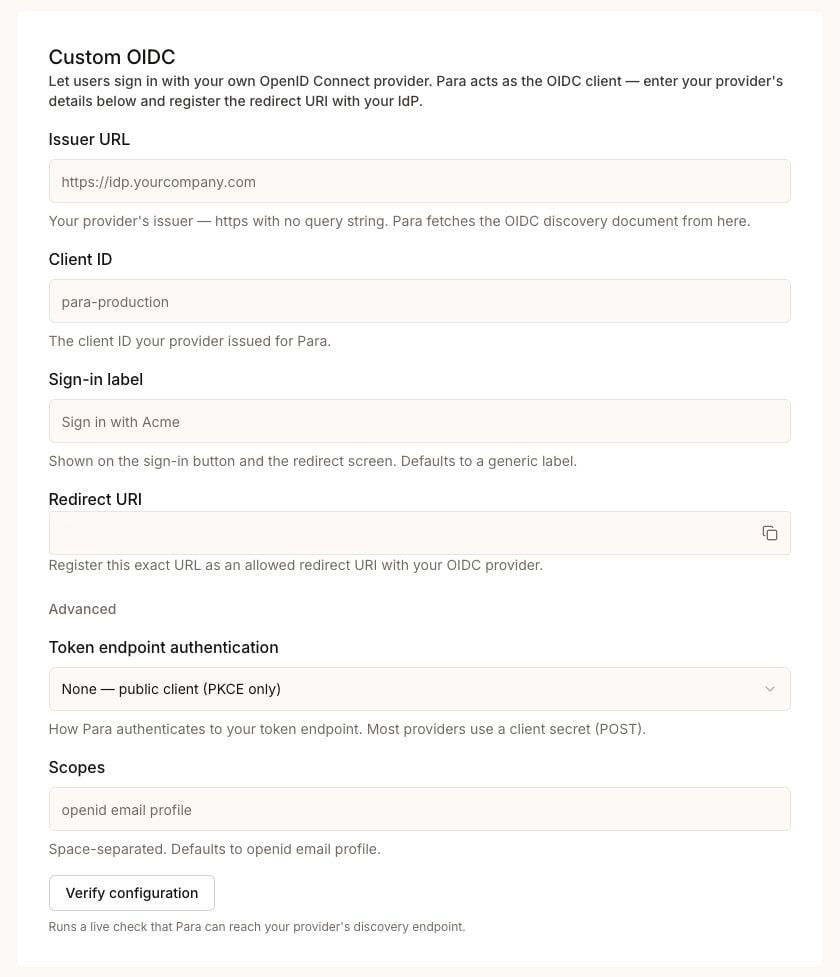
Configure the provider on your partner record from either the Developer Portal or the Para CLI — they write the same settings.- Developer Portal
- Para CLI
1
Open the Authentication screen
In the Developer Portal, select your project and API key, then go to Authentication and find the Custom OIDC section.
2
Enter your provider details
- Issuer URL — your provider’s issuer, e.g.
https://idp.yourcompany.com. Must behttpswith no query string. - Client ID — the client ID from step 1.
- Scopes — space-separated (defaults to
openid email profile). - Token endpoint authentication — how Para authenticates to your token endpoint (see authentication methods).
- Sign-in label — the text shown on the login button, e.g. “Sign in with Acme”.
3
Add your client secret
Enter the Client secret from step 1 and save it. It’s stored encrypted and never shown again. (Skip this if your client uses the
none authentication method.)4
Register the redirect URI
Copy the Redirect URI shown in the card and add it to your provider’s allowed redirect URIs (if you didn’t in step 1).
5
Verify
Click Verify — Para runs a live check against your provider’s discovery document and confirms it can reach it.
6
Enable Custom OIDC
In the Embedded Wallets method list, enable Custom OIDC so it appears as a login option.
3. Use it in your app
Once Custom OIDC is enabled, no extra SDK code is required to make it appear.With the Para Modal
The Para Modal renders a Custom OIDC button automatically, labeled with your sign-in label. Users tap it, sign in with your provider, and land back in your app with a Para wallet.With your own UI
If you build your own login UI, trigger Custom OIDC like any other OAuth provider — pass"CUSTOM_OIDC" as the method:
para.config.authConfig?.oidcConfig?.buttonLabel.
Custom OIDC works the same on every platform — it’s a
CUSTOM_OIDC OAuth method wherever Para authenticates. On mobile, follow your platform’s social-login guide and pass CUSTOM_OIDC as the method.Token endpoint authentication methods
Token endpoint authentication controls how Para authenticates to your provider’s token endpoint when it exchanges the authorization code:
Choose the method your provider expects for the client you registered.
client_secret_post and client_secret_basic require a client secret; none requires none.
Security
- Your client secret is write-only. Para stores it with KMS envelope encryption and never returns it. The CLI prompts for it without echoing, and it’s never written to
.pararc. - The issuer must be
httpswith no query string — this keeps credentials out of the stored issuer and any logs. A path is fine (https://idp.yourcompany.com/tenant-123). - Para validates your provider’s discovery document over the network when it connects; private and internal addresses are rejected.
Troubleshooting
The redirect fails with a redirect_uri mismatch
The redirect fails with a redirect_uri mismatch
The redirect URI registered with your provider must exactly match Para’s callback for the environment you’re using —
https://api.getpara.com/auth/custom_oidc/callback (production) or https://api.beta.getpara.com/auth/custom_oidc/callback (beta). Re-copy it from the Custom OIDC configuration.Verify fails, or login errors at the token step
Verify fails, or login errors at the token step
Your token endpoint authentication method must match what your provider expects. If your client is confidential, use
client_secret_post or client_secret_basic and make sure a secret is set. If it’s a public client, use none.The Issuer URL is rejected
The Issuer URL is rejected
The issuer must be
https with no query string, fragment, or credentials — just https://host/path. Para fetches your discovery document from {issuer}/.well-known/openid-configuration.Verify says Para can't reach your provider
Verify says Para can't reach your provider
Para couldn’t load your discovery document. Confirm the issuer is publicly reachable over HTTPS and serves a valid
/.well-known/openid-configuration.Custom OIDC vs Bring Your Own Auth
Both let you use your own identity system, but they’re different integrations:Next steps
Configure Authentication
The full Authentication screen — login methods, layout, and more.
Build a Custom UI
Authenticate without the Para Modal.