

replaceUserApprovalAssignments, binds the initiator’s and signers’ wallets to the scope with setWalletAuthorizationScope, and reads progress with getPartnerApprovalCase.
Collect wallet signatures from approvers for a transaction that needs several signers, such as a Safe transaction. Para checks each signer against the policy, gathers their signatures and returns them to the person who started the collection, who assembles and submits the final transaction.
Signature collection is a Request feature for user-owned wallets. Build and test it with a Development key on Para’s beta environment, and publish the policy to production through a production review.
How signature collection differs
A signature collection is a conditional approval case whose requirement hasevidence: "transaction_signature". Cases, stages, eligibility and expiry work the same way as other approvals, with these differences:
Para does not combine the signatures, sign the final transaction or broadcast it. Your app does that, and the onchain rules, such as a Safe’s owners and threshold, are separate from the roles in your policy.
Add the requirement
Add a rule withevidence: "transaction_signature" to a Request policy. The rule must match the transaction you collect signatures for, the same way it would match a signing request.
For a Safe transaction in the safe_eip712 format, Para reads the call inside it. A Safe payment of the chain’s native token matches transfer_native, and an ERC-20 transfer or transferFrom matches transfer_tokens. Facts such as request.to and request.value.baseUnits then describe that inner payment. A Safe transaction that uses DelegateCall (operation 1) matches execute_safe_transaction instead, and an inner call that is not one of these payments matches neither transfer action.
requiredApprovals so that the collection gathers at least as many signatures as the onchain threshold needs. Then assign the role to each signer and bind their wallets to the scope from your backend, as described in conditional approvals.
Start a collection
The initiator starts a collection from a signed-in session. The wallet must belong to the initiator, be connected to your app and be bound to an authorization scope.requestId is your own identifier for the collection, from 1 to 128 characters. transaction takes one of these formats:
chainId is a decimal string. If no rule with transaction_signature evidence matches, the call fails with 400 and no transaction signature requirement applies to this request. If a rule denies the transaction, it fails with POLICY_DENIED.
Collect signatures
Each signer adds a signature from their own Para wallet. The wallet must belong to the signer, match the wallet type of the format and be bound to the same scope as the collection.signApprovalTransaction reads the signing payload for the case, signs it with the signer’s wallet and submits the signature. To show the payload before the signer confirms, read it first with getApprovalSigningPayload(caseId), then sign and send the result with submitApprovalSignature(caseId, { walletId, signature }). EVM signatures are 0x-prefixed hex.
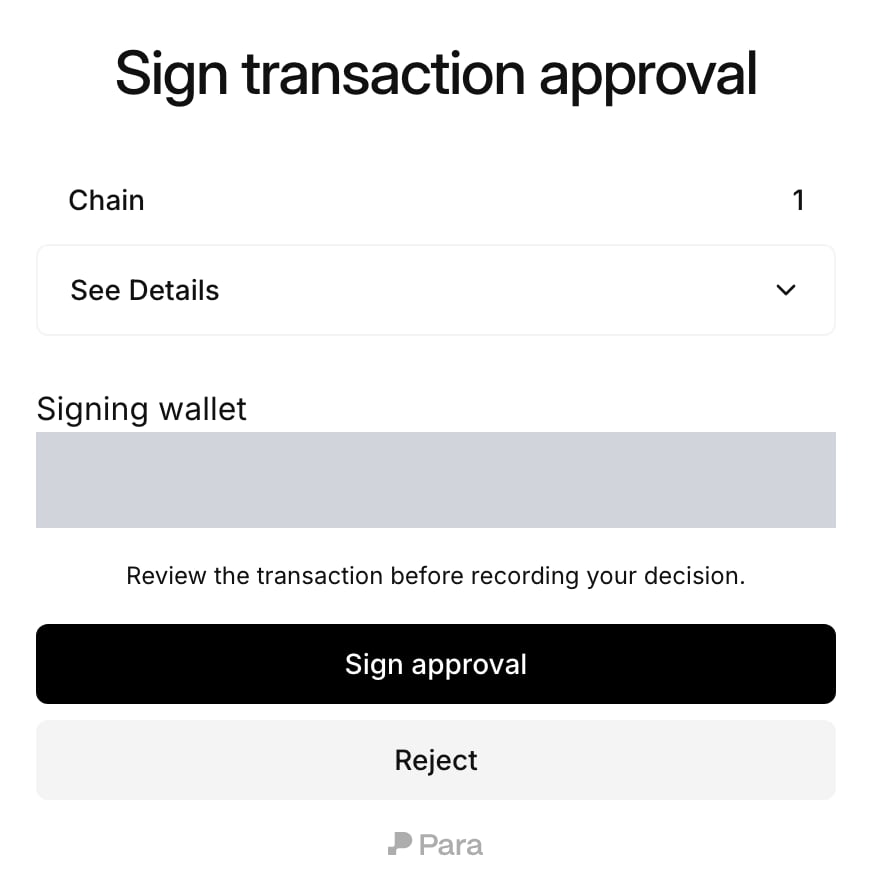
Signers can also use the Portal. getApprovalCaseReviewUrl({ caseId }) returns a link to a page titled Sign transaction approval, where the signer picks a Signing wallet and selects Sign approval. The page then shows Signature recorded.
rejectApprovalCase(caseId) in your app, ends the collection as rejected, the same way one rejection ends any other case.
Para does not notify signers. Send them the case ID or the Portal link through your own app. To withdraw a collection that is still pending, the initiator calls cancelApprovalCase(caseId), and the case ends as cancelled.
Retrieve the signatures
When the case iscompleted, the initiator reads the signatures:
signatures has the signer’s walletId, the signature and the signer’s actorId. The response also repeats the transaction, payloadDigest and signingPayloadBase64 the signers signed.
- Only the user who started the collection can read the signatures.
- The call returns
409until the case iscompleted. - Para checks the current policies again before it returns the signatures. If they no longer allow the transaction, the call returns
403withcompleted signature collection is denied by current policy, and you start a new collection. - A policy change ends a collection only when its own policy version stops applying, for example because it was replaced or turned off. The collection then becomes
invalidatedwithrequirement_unavailable. Changes to other policies leave it open, subject to the check above.
Assemble and submit the transaction
Combine the signatures in the form your multisig expects and submit the transaction yourself. For a Safe, map eachwalletId to its owner address, order the signatures the way the Safe contract requires and call execTransaction.